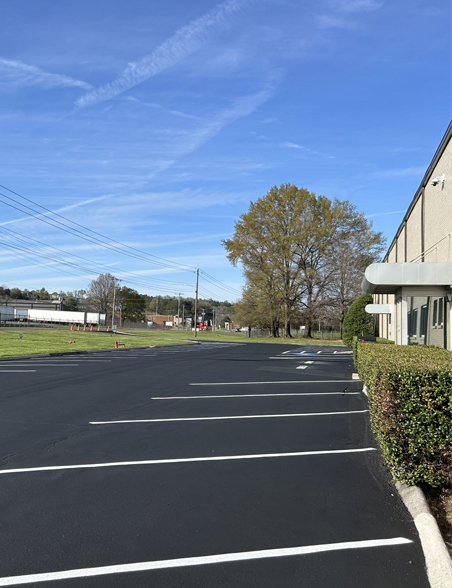
A truck traveling straight across stable pavement creates one kind of load. The same truck turning tightly near a loading area creates additional shear at the surface. Repeated braking and acceleration place more stress on entrances and drive lanes. Slow-moving heavy vehicles also hold their load over a smaller area for longer periods of time.
That is why high-use sections often fail before the rest of the lot.
Rutting can develop where repeated traffic pushes the pavement downward or sideways. Depressions may hold water, which adds another problem. Cracking often follows once the pavement loses uniform support.
Before deciding how to repair the area, crews need to understand whether the movement comes from the asphalt layer, the base below it, or both.
Rutting, Settlement & Full-Depth Failure
Rutting does not always have the same cause.
Sometimes the asphalt itself lacks enough stability under the traffic load. In other cases, the base or subgrade moves under repeated pressure. A settled area around a loading lane may point to deeper structural issues than ordinary surface wear.
The failure pattern usually provides clues.
If wheel paths have visible depressions but the surrounding pavement stays relatively sound, the problem may remain concentrated. Widespread alligator cracking, pumping, or repeated settlement can indicate that the section has lost support below the surface.
That is where full-depth repair enters the conversation.
Crews remove failed asphalt and unstable material until they reach a sound section. They rebuild the base as needed, compact it, and then place new asphalt over a stronger foundation. Simply adding another surface layer over movement underneath usually leaves the original problem in place.
Loading Areas & Truck Lanes Need Different Attention
Commercial properties often contain several pavement environments within the same lot.
Customer parking may see light passenger traffic. A rear service lane may handle daily deliveries. A loading area may support stopped trucks with concentrated axle loads. Dumpster approaches can take repeated turning and braking in a small footprint.
Those sections do not wear at the same rate.
A paving scope should reflect that difference. Full reconstruction may make sense in a failed loading area while the rest of the lot only needs localized repairs or surface maintenance.
Nance Pavement Solutions evaluates commercial pavement by use and condition instead of treating the property as one uniform surface. That can help keep usable pavement in place while directing deeper work toward the sections that actually need it.
Base Strength Matters More Under Heavy Loads
The pavement surface distributes traffic, but the base carries much of the structural demand.
If the aggregate below the asphalt lacks density or has become saturated, heavy vehicles expose that weakness quickly. The surface may flex, settle, or crack under repeated loads even when the asphalt itself was originally installed well.
Water makes those conditions worse.
Poor drainage around a loading lane or low commercial area can weaken support below the pavement. Once the section starts moving, truck traffic accelerates the deterioration.
That is why base evaluation belongs in heavy-use paving work. Crews need to look below the mat instead of assuming another lift will correct the problem.
On new commercial construction, proper subgrade preparation and aggregate compaction establish the structure before asphalt placement. On replacement work, removal gives crews a chance to identify weak areas and rebuild them before the new surface goes down.
Commercial Paving Without Rebuilding the Whole Property
A bad section does not always mean the whole lot is bad.
One entrance may have failed because of turning traffic. A truck lane may have rutting while employee parking remains stable. A loading zone may need full-depth reconstruction while the front lot still has useful pavement life.
Sectional work can make sense when the failure boundaries are clear.
Crews need to cut back to stable pavement, rebuild the failed area, and create clean transitions to the sections that remain. The repair also has to account for elevation so the finished surface does not create new low spots or abrupt joints.
This is where contractor judgment matters more than simply measuring damaged square footage.
Residential Asphalt Still Needs Proper Structure
Marion residential driveways carry lighter traffic, but the same basic failure mechanisms still apply.
Soft base material can cause settlement. Poor edge support can lead to cracking along the sides. Water can weaken already damaged areas. Repeated vehicle paths can expose weak sections near the garage or road.
Residential replacement gives crews an opportunity to correct those conditions before new asphalt goes down.
We look at base condition, grade, drainage, and existing tie-ins. Private roads and longer drives may require more attention where the pavement crosses softer ground or changes elevation.
The traffic load may be lighter, but preparation still determines how the surface performs.
Maintenance Belongs on Structurally Sound Pavement
Sealcoating and striping can extend the usefulness and appearance of commercial pavement, but they do not rebuild failed structure.
A heavily rutted truck lane needs repair before any surface treatment makes sense. A pothole with unstable material underneath needs more than sealer. Parking lot markings belong after the pavement itself is in suitable condition.
Nance Pavement Solutions handles paving, full-depth repairs, sealcoating, and striping so the scope can match the actual condition of the property.
When comparing asphalt paving contractors Marion OH businesses and property owners can hire, look at how they talk about traffic and failure depth. Heavy-use pavement needs more than a cosmetic fix when the structure underneath has already started moving.