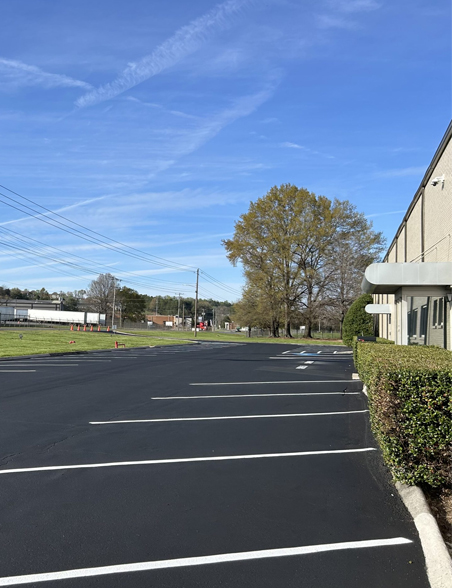
A commercial lot may contain several distinct areas even when it looks like one continuous paved surface. The main entrance may carry nearly every vehicle entering the property. A rear drive may handle deliveries. Employees may park in a separate section from customers.
Closing all of it at once may not make sense.
When the site allows it, paving can sometimes move through the property in phases. One section closes while traffic uses another. After the first area reaches the point where it can reopen, crews can move into the next phase.
That sounds straightforward, but poor sequencing can create problems. Equipment needs room to operate. Trucks need access to the paving crew. Drivers cannot safely cross an active work area simply because another part of the property remains open.
The paving plan has to balance construction needs with the way the property operates.
Entrances Deserve Their Own Attention
Entrances often take more abuse than the interior of a parking lot. Vehicles brake as they approach the road, turn sharply, and accelerate back into traffic. Delivery trucks may use the same entrance repeatedly.
That combination can expose weak pavement faster than normal parking traffic.
An entrance with widespread cracking or repeated patch failure may need deeper work than an adjoining drive lane. If the base has lost support, another surface patch will not restore the structure underneath.
Entrances also involve elevations that crews cannot ignore. New asphalt needs to meet the road, curb, gutter, or adjoining pavement without creating a poor transition or trapping water.
That is one reason we evaluate commercial lots by section rather than assuming the same repair depth applies everywhere.
Phased Paving & Joint Construction
Phased work creates joints between paving sections. Those joints need attention because they become part of the finished pavement after the rest of the equipment leaves.
A paving crew may place one section while the adjoining pavement remains in service. When the next phase begins, crews need a clean edge and a workable elevation for the new asphalt to meet the previous section.
Poorly compacted joints can become early points of deterioration. Water can enter openings between sections, and traffic can work against unsupported edges.
Good joint construction starts before the second mat reaches the pavement. Crews need to prepare the edge, manage the overlap, and compact the joint while the new material remains workable.
This becomes especially important in parking lots paved over several phases. The finished lot may contain several construction joints even though drivers see one continuous surface.
Deciding What to Remove & What to Keep
A busy Gahanna parking lot may contain pavement in several different conditions.
One drive lane may have full-depth cracking. Parking stalls farther away may only show surface aging. An entrance may have settled around an old repair while the pavement beside it remains stable.
Removing every square foot of asphalt can waste usable pavement. Covering every problem with an overlay can create a different kind of waste if failures underneath remain active.
The repair scope should follow the failure.
Localized base problems can require full-depth removal and reconstruction. Surface deterioration over otherwise stable pavement may support another approach. Milling can also help when the project needs to remove deteriorated material, adjust elevations, or prepare an existing surface for additional asphalt.
The important part is separating structural failures from areas that still have useful pavement life.
Commercial Traffic Changes the Paving Plan
Commercial pavement does not receive uniform loading. The sections that carry the most traffic often show the first meaningful failures.
Delivery lanes may see heavier loads than customer parking areas. Tight turns create additional stress at the pavement surface. Dumpster approaches, loading zones, and service entrances can also take repeated concentrated loads.
Those areas deserve closer inspection before crews decide how much pavement to remove.
A stable surface over a sound base can handle traffic differently than asphalt sitting over saturated or poorly compacted material. Adding more asphalt does not compensate for support that has already failed below the surface.
Nance Pavement Solutions looks at the pavement section along with the traffic above it. That helps determine whether the work belongs at the surface or needs to go deeper.
Residential Paving in Gahanna
Residential paving involves fewer operational constraints, but homeowners still benefit from the same attention to grade, base condition, and transitions.
Driveway replacement often starts by removing the existing asphalt and looking at what it leaves behind. Soft areas, settlement near the garage, or weak edges may need correction before new pavement goes down.
The driveway also has to fit the elevations already on the property. Asphalt may meet a concrete garage apron, sidewalk, street, or adjoining parking pad. Those tie-ins need to drain correctly and provide a usable transition for vehicles.
Private drives and longer residential access areas can introduce additional grade changes or edge-support concerns. We account for those conditions when planning the paving section rather than treating every driveway as a simple rectangular mat.
Parking Lot Maintenance After Paving
New asphalt is only one part of commercial pavement management.
As the lot ages, localized repairs may become necessary in heavily used sections. Sealcoating can provide surface protection when the asphalt remains an appropriate candidate. Parking lot striping restores parking spaces, directional markings, and other layout elements after paving or maintenance work.
These services belong at different stages of pavement life.
Sealcoating does not correct failed base material. Striping does not solve settlement. A patch makes sense when the failure remains localized. Larger structural problems need a larger repair scope.
Nance Pavement Solutions works across paving, repair, sealcoating, and striping, which lets us look at the condition of the lot before deciding which service belongs there.
When comparing asphalt paving contractors Gahanna OH property owners can work with, ask how the contractor plans to keep the property functioning during the job. On commercial sites, the paving sequence, access plan, repair depth, and finished joints can matter just as much as the asphalt itself.